
You open a job board and see two listings with nearly identical bullet points — one labeled "Developer," the other "Software Engineer." Most people treat them as synonyms, but these titles signal different day-to-day realities and long-term career paths.
The most significant difference: Developers focus on building features, while engineers design the entire system that enables those features.
In this article, we'll compare the career paths of software engineers and developers across core areas — scope of work, collaboration style, technical breadth, education, and pay. You'll get a side-by-side table that distills the contrasts, and straightforward advice on which role rewards which personality traits.
Job ads often blur the line between these titles, so understanding the differences up front helps you choose the right courses, negotiate better offers, and plan your career moves.
5 key differences between a software engineer and a developer
Software engineers are the architects who see the whole city grid. Developers are the builders focused on delivering the next skyscraper. Engineers think in systems: mapping how every component scales and survives change. Developers have a build-and-ship mindset that gets features into users' hands quickly.
Here’s how they differ at a glance:
Scope of work and problem-solving depth
Software engineers start by asking how a system will behave in a few years. They sketch data flows, choose architectural patterns, and anticipate performance bottlenecks before writing code.
Developers zoom in on immediate deliverables: building a fast, intuitive search feature. Engineering energizes you if macro-level trade-offs (latency vs. cost, security vs. speed) feel like home. Development delivers immediate satisfaction from elegant code that works.
Engineers also guard the system's long-term health, so they sync with DevOps on deployment pipelines, QA on testing strategy, and product managers on feasibility. Developers spend time in code reviews, pair programming, and client calls to clarify feature details.
Engineering fits if negotiating between diverse stakeholders sounds exciting. Development works if deep dives with fellow coders light you up.
Technical skill breadth
An engineer's toolkit spans load balancers, CI/CD pipelines, and algorithmic optimizations. Developers channel energy into a narrower stack (React, Node, etc.), pushing each tool to its creative limits. Engineering satisfies constant context-switching across domains. Development rewards the perfection of craftsmanship within one ecosystem.
Many engineering roles list a bachelor's degree in computer science or software engineering as a baseline, reflecting the math and systems theory involved. Developer job ads increasingly welcome bootcamp graduates or self-taught coders with substantial portfolios.
Engineering aligns with formal academia and structured rigor. Development keeps the door wide open after intensive bootcamps or self-directed learning.
As regards compensation, engineering offers the higher ceiling for maximum earning potential and strategic influence. Development provides a quicker launchpad with rapid entry and tangible feature ownership.
Skills and responsibilities
As a software engineer, your week revolves around architecture sessions, technical specifications, and cross-team problem solving:
- System architecture and design: Creating high-level architecture diagrams that show data flow, interfaces, and dependency boundaries for new features or entire applications.
- Requirements analysis: Working with stakeholders to translate product ideas into technical specifications that flag edge cases and define success criteria before development begins.
- Tool selection and development: Choosing or building internal tools that boost team productivity while maintaining consistency with existing infrastructure.
- System optimization: Enforcing performance, scalability, and security targets through code reviews, load testing, and continuous monitoring of production systems.
- Cross-functional collaboration: Syncing with QA on testing strategy, DevOps on deployment pipelines, product managers on feasibility, and sometimes clients on technical requirements.
However, as a developer, your day revolves around coding and implementation, with these core activities defining your workflow:
- Coding and implementation: Writing and refactoring source code in languages like JavaScript, Python, or C# that transforms specifications into working features users interact with
- Feature development: Translating product requirements into functional screens, APIs, or background jobs that deliver the intended user experience
- Testing and debugging: Running unit tests, stepping through stack traces, and fixing bugs to deliver clean pull requests that won't break the build
- Documentation: Crafting concise README files, inline comments, and API notes so teammates can extend your work without guesswork
- Continuing education: Staying current with emerging frameworks and libraries — React one year, perhaps Svelte or Rust the next — because tooling changes fast and your value tracks with it
The work is hands-on, iterative, and often feels more like craftsmanship than engineering, which is why many describe the job as equal parts logic and art.
Career paths
Most software engineers start by owning small services or modules, then graduate to system-wide authority:
- Backend engineer (software architect): Progress from implementing individual services to designing entire system architectures and making technology decisions that affect how all services interact and scale.
- DevOps engineer (site reliability engineer): Specialize in infrastructure automation, monitoring, and reliability engineering that keeps systems running smoothly at scale while minimizing manual intervention.
- Specialized paths: Front-end engineer focusing on performance optimization, back-end engineer handling scalability challenges, DevOps engineer automating deployment workflows, security engineer hardening systems against threats, or cloud architect designing infrastructure on AWS, Azure, or Google Cloud.
For developers, their career starts at a junior level, where they ship minor bug fixes and learn the codebase:
- Junior to senior developer: A typical progression that involves gaining experience and taking on more complex projects
- Technical Lead: Oversees a team of developers, guides technical solutions, and mentors team members
- Software architect: Designs the overall structure of software systems
- Engineering manager: Manages engineering teams and projects.
- Specialized tracks: Web developer mastering front-end frameworks, mobile app developer building iOS or Android applications, full-stack developer handling both client and server code, game developer creating interactive experiences, or QA automation developer building test frameworks.
Each path deepens your influence over how complex systems are conceived, built, and evolved, making this role ideal if you thrive on big-picture thinking and long-term technical stewardship.
How organizational dysfunction erases the engineer-developer boundary
Most companies claim to hire both engineers and developers, but in practice, they collapse both roles into "person who codes" because they lack the infrastructure to value the distinction.
When platforms can't measure whether an architectural decision will prevent technical debt in two years, they default to measuring what's visible today: lines of code committed, story points completed, features shipped. The metrics favor development work because engineering work is more challenging to quantify.
The result: engineers who can design scalable systems spend their days implementing features, while developers who excel at implementation are pushed into architecture decisions they're not equipped to make.
Neither role is performed well, and burnout accelerates because people are evaluated on tasks that don't align with their strengths.
When companies can't measure architecture, they measure activity
Here's the tell: you're in an interview, and the hiring manager asks, "Are you more of a systems thinker or a hands-on coder?" Then, three months in, you're being evaluated on sprint velocity and ticket closure rates.
The company can't actually measure systems thinking. They don't have tools to assess whether your database schema will scale, whether your API contracts will survive version changes, or whether your service boundaries will prevent cascading failures. So they measure activity: commits, deploys, and features launched.
Architectural decisions compound slowly. The choice to use microservices versus a monolith plays out over years, not sprints. The decision to normalize your database rather than denormalize for speed creates a maintenance burden that accumulates over time. The API versioning strategy you choose determines how painful migrations become.
But performance reviews happen quarterly in most setups. Managers need metrics that show progress now. Story points go up, velocity increases, features ship — these metrics look good in dashboards even if the underlying architecture is collapsing.
So even if you were hired as an "engineer" to think about systems, your performance review will most likely measure developer output. The distinction becomes meaningless because the company doesn't have the infrastructure to value the work you were supposed to do.
The promotion incentive that destroys systems thinking
The promotion track at most companies actively punishes engineering thinking and rewards visible development work.
Want to get promoted? Don't spend months redesigning the authentication system to prevent a whole class of security vulnerabilities. That's invisible work. One engineer, one system, no drama — no promotion.
Instead:
- Launch a new microservice (adds architectural complexity, proves you can "lead initiatives")
- Build a feature that gets exec attention (visible user impact beats invisible infrastructure)
- Coordinate a cross-team project (visibility with leadership, even if it creates coordination overhead)
- Migrate something to the latest framework (generates activity metrics, regardless of whether it was needed)
Actual engineering work (the architectural decisions that prevent expensive rewrites, the database design that scales gracefully, the API contracts that survive version changes), this work generates no promotion visibility because it prevents problems that never happen.
The developers who get promoted are the ones who ship visible features fast. The engineers who get promoted are those who behave like senior developers, even with lower titles. The engineers who actually think about systems? They might stay at the same level for years or leave.
You end up with "senior engineers" who've never designed a system from scratch, only bolted features onto existing architectures. And when architectural decisions do need to be made, they're made by people optimizing for promotion visibility, not long-term system health.
How AI training at DataAnnotation rewards your coding expertise
At this point, almost every coder has encountered AI-generated code. You've probably used it to write boilerplate, debug issues, or explore unfamiliar libraries. The code works sometimes. Other times, it confidently produces solutions that fail in subtle ways.
That gap between "code that compiles" and "code you'd actually ship"? Companies will pay you to evaluate it.
Models improve by learning from developers and engineers who can articulate that gap — who can explain not just that generated code is wrong, but why it's bad and what would make it better.
At DataAnnotation, AI training involves technical judgment, not task completion:
- You evaluate code generated by AI systems for correctness, efficiency, and edge case handling
- You rank chatbot responses based on technical accuracy and adherence to instructions
- You review solutions to complex problems and identify where reasoning breaks down
- You label technical content with domain expertise so models learn to distinguish quality
This pays more than freelance platforms because your tier is determined by assessment, not bidding against the cheapest competitor.
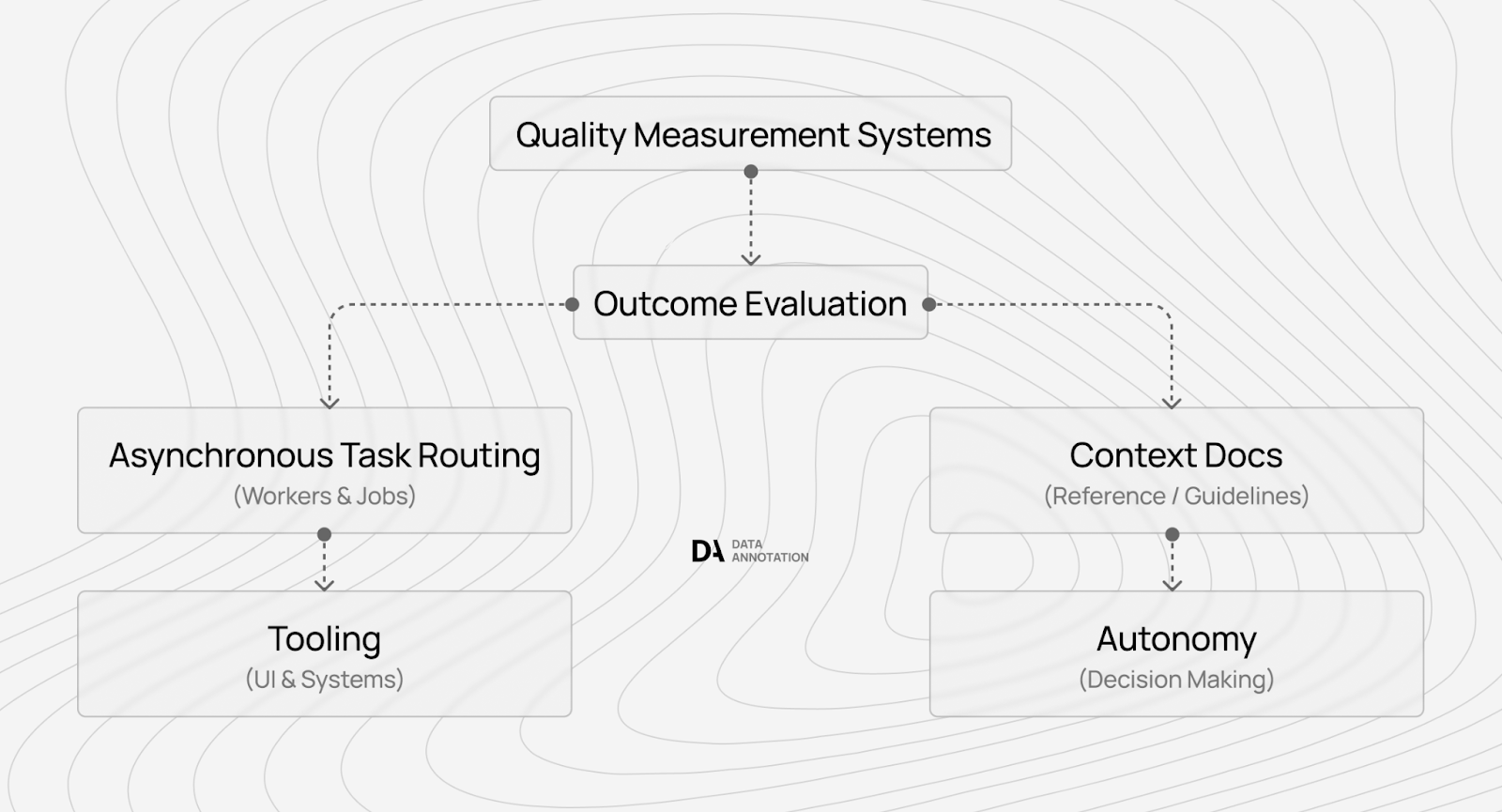
However, at DataAnnotation, we maintain selective standards because quality at the frontier scale requires genuine expertise, not just effort. If you're exploring AI training work because you heard it's easy money that anyone can do, we’re afraid, this isn't the right platform.
If you're looking to maximize hourly volume through minimal-effort clicking, there are commodity platforms better suited to that approach. If credentials matter more to you than demonstrated capability, our qualification process can discourage you.
Explore flexible coding projects at DataAnnotation
If you want to work where code quality determines frontier AI advancement and expertise compounds over time, DataAnnotation offers immediate access after a single qualification assessment.
If you want in, getting started is straightforward:
- Visit the DataAnnotation application page and click “Apply”
- Fill out the brief form with your background and availability
- Complete the Starter Assessment
- Check your inbox for the approval decision (which should arrive within a few days)
- Log in to your dashboard, choose your first project, and start earning
No signup fees. We stay selective to maintain quality standards. Just remember: you can only take the Starter Assessment once, so prepare thoroughly before starting.
Apply to DataAnnotation if you understand why quality beats volume in advancing frontier AI — and you have the expertise to contribute.
.jpeg)